Man Talk may earn a commission when you buy through links on this page. That never changes what gets recommended, and it never changes the price you pay.
Best Budget Sim Racing Wheels for Beginners
The best budget sim racing wheel for most beginners is the Logitech G29, at around $230 on sale, or its Xbox twin, the G920. Spending closer to $300 buys the Moza R3 bundle, which brings direct drive force feedback to PC at an entry price. The Thrustmaster T128, at roughly $200, is the cheapest wheel with force feedback still worth owning. Those three answers cover most buyers, but the details decide the right pick. Drive type shapes how a wheel feels in your hands. Console licensing decides whether a wheel works on your machine at all. Pedal quality decides whether braking feels precise or vague. This guide compares eight beginner bundles on all three points, plus one stretch pick above them. Every claim rests on published specs and the documented consensus of the sim racing community, not marketing copy. The traps get covered too: vibration-only fakes, dated pricing, and bundles that need extra parts. Prices in this class shift weekly, so treat every figure here as approximate.
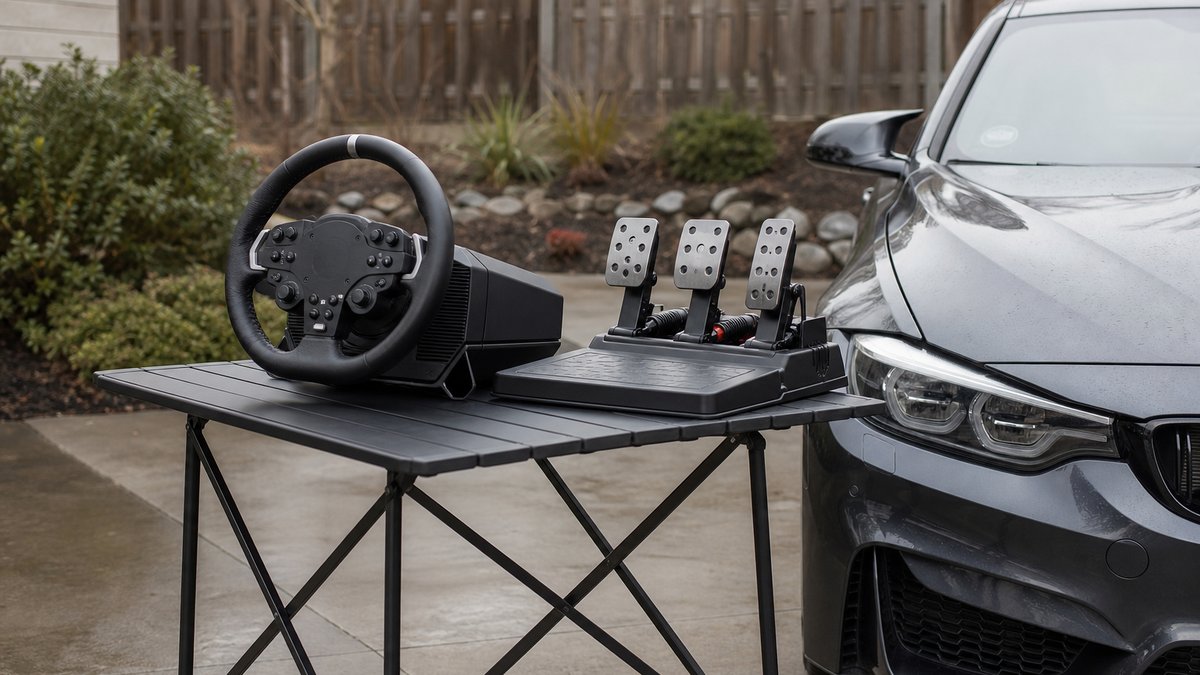
The picks at a glance
Eight bundles stand out for beginners in 2026. They are the Thrustmaster T128, Logitech G29, Logitech G920, Logitech G923, Thrustmaster T248, PXN V10 Ultra, Moza R3, and Moza R5. The Fanatec CSL DD sits above them as the stretch pick worth saving toward.
| Wheel | Typical price | Drive type | Platforms | Best for |
|---|---|---|---|---|
| Thrustmaster T128 | ~$200 | Hybrid belt-gear | PC + PS or Xbox version | Lowest real budget |
| Logitech G29 | ~$230 on sale | Gear | PC, PS4, PS5 | PlayStation value |
| Logitech G920 | ~$230 on sale | Gear | PC, Xbox | Xbox value |
| Logitech G923 | ~$300 on sale | Gear + Trueforce | PC + PS or Xbox version | Quieter Logitech feel |
| Thrustmaster T248 | ~$330 | Hybrid belt-gear | PC + PS or Xbox version | Features per dollar |
| PXN V10 Ultra | ~$260 | Direct drive | PC, PS4, Xbox (no PS5) | Cheapest direct drive |
| Moza R3 bundle | ~$299 PC / ~$359 Xbox | Direct drive | PC, or PC + Xbox | Best feel under $300 |
| Moza R5 bundle | ~$399 | Direct drive | PC only | Best PC feel under $400 |
| Fanatec CSL DD | ~$550+ bundled | Direct drive | PC, Xbox (PS via GT DD Pro) | The stretch pick |
Street prices on racing wheels swing hard around sales events, sometimes by $100 or more. Treat the numbers above as typical sale-season prices, not guarantees. Man Talk staff bring decades of combined gaming experience, including years spent on racing simulators.
How these picks were chosen
Every pick had to pass four tests. The tests: real force feedback, a complete wheel-and-pedals bundle, support for PC or a current console, and a track record in community reviews. Man Talk built this list from published specifications and the documented consensus of the r/simracing community and specialist sim racing outlets, not from paid placements.
Those tests cut deeper than they sound. Marketplaces are full of cheap wheels that only vibrate, with a spring pulling the rim back to center. The Hori RWA and PXN V900 fall in that group, and both fail the first test. Force feedback is the entire point of a racing wheel. It communicates grip, steering weight, and curb strikes through the rim, and no rumble motor fakes that. A vibration wheel teaches nothing about car control and gets outgrown in weeks.
Where marketing and owner reports disagree, this guide sides with the owners. No first-person testing claims appear here. When a claim needs a source, it comes from documented owner reports and published reviews from outlets that bench these wheels for a living.
Gear vs belt vs direct drive: what the money buys
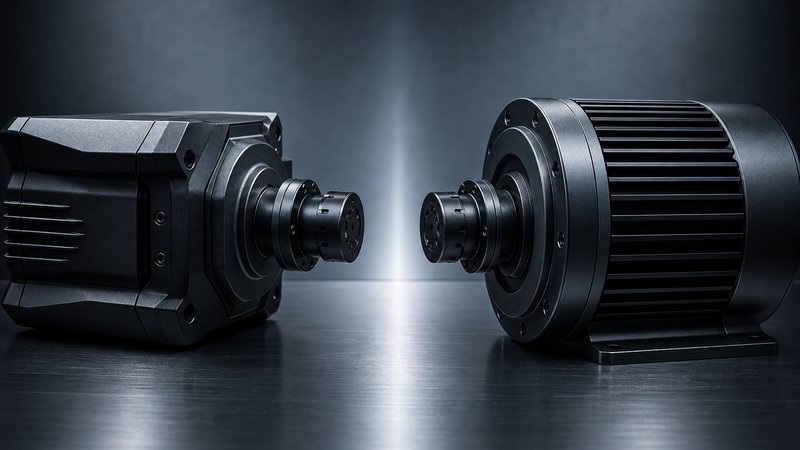
Three force feedback designs exist at beginner prices. Gear-driven wheels are the cheapest and the noisiest. Belt and hybrid wheels run smoother and quieter. Direct drive wheels connect the rim straight to the motor and feel the best by a wide margin.
Torque numbers tell part of the story. The gear-driven Logitech wheels put out roughly 2.3Nm at peak. The hybrid Thrustmasters land between 2Nm and 3.5Nm. The Moza R3's motor holds 3.9Nm constantly rather than at peak, and the R5 holds 5.5Nm. PXN's V10 Ultra peaks at 3.2Nm through a direct motor connection. Constant torque matters because gears and belts absorb small forces before they reach your hands. A direct drive motor passes those small forces straight through, which is where the detail lives.
| Drive type | Mechanism | Typical torque | Character | Found on |
|---|---|---|---|---|
| Gear | Motor drives the rim through gears | ~2 to 2.3Nm peak | Notchy, rattly, proven | G29, G920, G923 |
| Hybrid belt-gear | Belt smooths a geared motor | ~2 to 3.5Nm peak | Smoother, quieter | T128, T248 |
| Direct drive | Motor sits on the wheel shaft | ~3.2 to 5.5Nm | Smooth, detailed, strong | PXN V10 Ultra, Moza R3, R5, CSL DD |
Is direct drive overkill for a first wheel?
No, and the old advice to start on gears is fading. Direct drive used to cost four figures, so beginners had no real choice. The Moza R3 changed that math at roughly $299. Community threads now regularly point first-time PC buyers straight at entry direct drive. The honest counterpoint: a $230 G29 leaves budget for games, a wheel stand, or better pedals. Skill also transfers between drive types, so nobody gets ruined by starting on gears.
Logitech G29 and G920: the proven starting point (~$230)
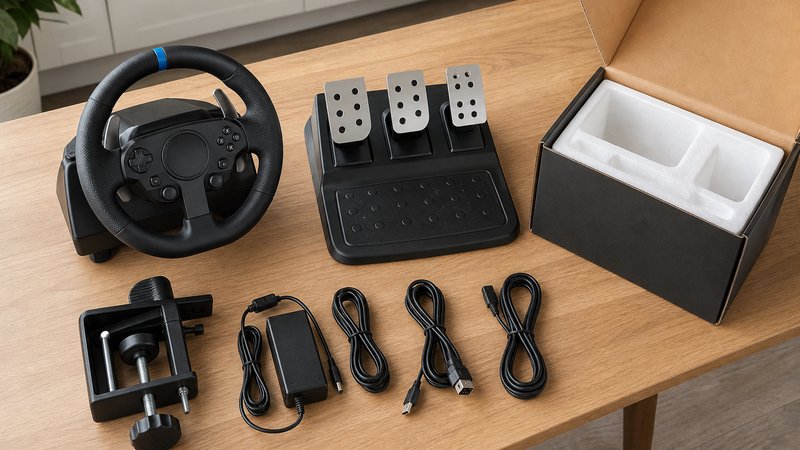
The Logitech G29 is the default first wheel for PlayStation and PC, and the G920 is the same hardware licensed for Xbox. Both are gear-driven, rotate 900 degrees, and sell for around $230 during sales.
The G29 launched back in 2015, which sounds damning but mostly works in its favor. A decade of production means proven reliability, near-universal game support, and mountains of setup guides. The hardware still feels more expensive than it is. The rim wears stitched leather, the shift paddles are stainless steel, and the three-pedal set uses steel faceplates.
The flaws are equally well documented. Gear-driven force feedback rattles and clunks over curbs, loudly enough to notice in a quiet room. The pedal potentiometers collect dust, and owners report sticky or spiking pedals after a year or two without a cleaning. The G920 also drops the G29's selection dial and LED shift lights, an odd cut for the same money.
None of that sinks the recommendation. At the frequent $230 sale price, nothing PlayStation-licensed matches this package. At the full $329 list price, the math changes and the Moza R3 becomes hard to ignore.
Logitech G923: the quieter sibling (~$300)
The Logitech G923 is a refined G29 with Trueforce, Logitech's high-frequency force feedback layer. It arrived in August 2020 in separate PlayStation and Xbox versions and typically sells around $300 on sale.
Trueforce adds engine vibration and road texture in supported titles, though only a limited list of games uses it. Owner opinion splits down the middle, with some finding it immersive and others finding it distracting. The concrete upgrades are less debatable: quieter, less rattly feedback and a progressive brake spring that improves pedal modulation. The Xbox version also keeps the dial and shift lights that the G920 loses, which makes it the nicer Logitech option on that platform.
The value question is simple. On sale near the G29's price, the G923 is the better buy of the two. At its $399 list price, an entry direct drive bundle costs the same and feels a class better.
Thrustmaster T128: the cheapest wheel worth owning (~$200)
The Thrustmaster T128 is the floor for real force feedback, at roughly $200. It pairs a 2Nm hybrid belt-and-gear system with 900 degrees of rotation and magnetic shift paddles.
Magnetic paddles at this price are a small luxury. They click crisply and never wear out the way contact switches do. The force feedback reads smoother than the price suggests, and reviewers consistently call this the best value in the class. Separate PlayStation and Xbox variants exist, and both include PC support. Four small LED rev lights and 13 buttons cover the basics.
The compromises are plain. Hard plastic covers nearly everything, including the rim, which gets uncomfortable in long sessions without gloves. The included two-pedal T2PM set has short travel, which makes precise braking harder than it should be. Thrustmaster's ecosystem softens that, since the pedals can be upgraded later without replacing the wheel.
Thrustmaster T248: the feature pick (~$330)
The Thrustmaster T248 stacks features no rival matches at its price: a telemetry screen, 25 buttons, a leather-wrapped rim, and the three-pedal T3PM set. Its hybrid force feedback peaks at 3.5Nm.
The built-in screen shows lap times, rev lights, and force feedback strength, and settings adjust without touching a menu on the TV. The T3PM pedals include a clutch and a swappable brake spring for heavier resistance. PlayStation and Xbox versions both exist, and both work on PC. For console racers who want one tidy package, the spec sheet is genuinely strong.
Community reviews flag two consistent gripes. The shifters sound clunky rather than satisfying, and the hybrid feedback can feel scratchy next to a direct drive base. At around $330, the T248 competes directly with the Moza R3, which is tough company. It makes sense for PlayStation and Xbox racers who value the screen and pedals; PC-only buyers have better options.
PXN V10 Ultra: the direct drive wildcard (~$260)
The PXN V10 Ultra is the cheapest complete direct drive bundle on the market, at roughly $260. It pairs a 3.2Nm peak direct drive base with a 270mm leather-wrapped rim and Hall-effect pedals.
PXN built its name on cheap vibration wheels, so skepticism is fair here. The V10 Ultra is a different class of product. Its motor drives the wheel shaft directly, and published reviews describe the feedback as smooth and consistent for the money. TweakTown's June 2026 review recommended the bundle and noted that it undercuts every rival direct drive package. The two-pedal set uses Hall-effect sensors, which read position magnetically and never wear the way potentiometers do. A snap-in brake elastomer ships in the accessory box for firmer, more readable braking.
The caveats deserve equal billing. Peak torque of 3.2Nm trails the Moza R3's 3.9Nm constant rating. The 270mm rim runs smaller than the 280mm to 300mm class norm, which reads twitchy to some drivers. PXN's software and long-term support also lack the track record Logitech and Moza have earned over years. Console coverage is the strangest part. PXN lists PS4, Xbox One, and Xbox Series support alongside PC, but PS5 is absent from the list. PS5 owners should treat this wheel as incompatible until PXN's own compatibility page says otherwise.
Moza R3 bundle: direct drive on a budget (~$299)
The Moza R3 bundle is the cheapest direct drive package from a major brand, at about $299 for the PC version. It holds 3.9Nm of constant torque and outclasses every gear and belt wheel here on feel.
The bundle includes the R3 wheelbase, the ES steering wheel with an aluminum frame and microfiber leather grips, and the SR-P Lite pedals. LED shift lights and aluminum paddles round out a spec sheet that reads above its price. Moza's Pit House software handles tuning, and community consensus rates it among the better tuning suites at any price. Full bundle specs are published at Moza's official site.
Two caveats before ordering. The SR-P Lite pedals lack braking resistance out of the box, and the common fix is a performance spring kit that costs under $30. Console players pay more, since the Xbox-licensed bundle runs about $359 and no PlayStation version exists at all. For PC-first racers, this is the strongest sub-$300 recommendation going.
Moza R5 and Fanatec CSL DD: the stretch picks
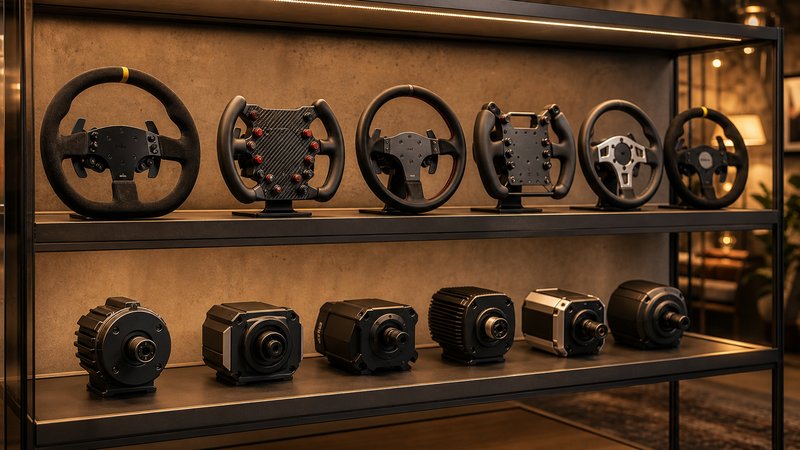
Two direct drive options sit just above budget territory. The Moza R5 bundle runs about $399 with 5.5Nm of torque, on PC only. Fanatec's CSL DD starts near $350 for the bare wheelbase, with complete bundles around $550 and up.
The R5 bundle is the natural upsell from the R3. It pairs the same ES wheel and SR-P Lite pedals with a stronger 5.5Nm base, and street prices have dipped near $425 during sales. For a PC racer who knows the hobby will stick, the extra torque buys years of headroom before any upgrade itch returns.
Fanatec plays a different game. The CSL DD is a modular 5Nm wheelbase, boostable to 8Nm with an add-on power kit. Rims and pedals are bought separately or arrive together in Ready2Race bundles. Xbox support comes through Xbox-licensed rims, while PlayStation requires the separate GT DD Pro variant instead. Bundle pricing between roughly $550 and $700 leaves beginner territory, but few platforms are better supported long term. Current bases, rims, and bundle configurations are listed at Fanatec's official site.
Alternatives considered and rejected
Five wheels that show up in beginner searches did not make the list. They are the Cammus C5, Thrustmaster T300RS GT, Logitech Pro Racing Wheel, Hori Racing Wheel Apex, and PXN V900. Each one fails at least one of the four selection tests.
Cammus C5. The C5 squeezes a full 5Nm direct drive motor inside the wheel rim itself, at around $300. Reviewers rate its force feedback well, and the all-metal build reads above the price. It fails the bundle test, though, since no pedals ship in the box and the wheel is PC-only. Adding pedals pushes the total toward Moza R5 money, with far less ecosystem behind it.
Thrustmaster T300RS GT. A belt-driven PlayStation favorite for a decade, and still a genuinely good wheel. Its roughly $400 list price is the problem, since direct drive now sells for less. It earns a stronger look on the used market, covered below.
Logitech Pro Racing Wheel. An 11Nm direct drive flagship priced near $1,000 before pedals. The hardware reviews well, but nothing about the price fits a first-wheel budget.
Hori Racing Wheel Apex and PXN V900. Both sell in volume at around $100, and both fail the force feedback test. A spring centers the rim, and rumble motors fake the rest. No motorized feedback means no place on this list, whatever the star ratings suggest.
Console compatibility decoder
Wheel licensing is platform-locked, and buying the wrong variant means a wheel that will not connect. Every recommended wheel in this guide runs on PC. The table below decodes PlayStation and Xbox support for every wheel this guide mentions.
| Wheel | PC | PlayStation | Xbox |
|---|---|---|---|
| Logitech G29 | Yes | PS4, PS5 | No |
| Logitech G920 | Yes | No | Yes |
| Logitech G923 | Yes | PS version | Xbox version |
| Thrustmaster T128 | Yes | PS version | Xbox version |
| Thrustmaster T248 | Yes | PS version | Xbox version |
| Thrustmaster T300RS GT | Yes | PS4, PS5 | No |
| PXN V10 Ultra | Yes | PS4 only, no PS5 listed | Xbox One, Xbox Series |
| Cammus C5 | Yes | No | No |
| Moza R3 bundle | Yes | No | Xbox bundle only |
| Moza R5 bundle | Yes | No | No |
| Fanatec CSL DD | Yes | No, needs GT DD Pro | With licensed rim |
| Thrustmaster T150 (used) | Yes | PS4, PS5 | No |
| Logitech G27 (used) | Yes | No | No |
Current racing titles raise the stakes here. F1 25 and other current releases require a PS5 or an Xbox Series console. The wheel must therefore support the current generation, not just the last one. Every wheel in the table supports current consoles where marked, per manufacturer compatibility lists. The PXN V10 Ultra row deserves a second look, since PS4-only support locks out current PlayStation releases. The rejected Hori Apex and PXN V900 connect to consoles too, but without force feedback, compatibility is beside the point.
What if you race on both PlayStation and Xbox?
No budget bundle covers both consoles at once, and licensing is the reason rather than hardware. Sony and Microsoft certify wheels separately, and manufacturers pay for each license. The practical answer is to buy for the console you race on most, since PC support tags along either way. The expensive answer is Fanatec's GT DD Pro with an added Xbox-licensed rim, a combination that clears $700.
What to check before buying any beginner wheel
Five checks separate a good first purchase from a return: platform license, real force feedback, mounting, the pedal upgrade path, and the brand ecosystem.
- Platform license. Confirm the exact variant matches your machine. A PlayStation T248 will not run on Xbox, and a G920 will not run on PS5. The box art looks nearly identical between versions.
- Real force feedback. If a listing says vibration feedback or spring resistance, walk away. Motorized force feedback is the minimum standard, and every wheel in this guide has it.
- Mounting. Every bundle here clamps to a desk, but clamp quality varies. Check that the desk edge is thick enough and that the base offers hard-mount holes for a future cockpit.
- Pedal upgrade path. Pedals shape lap times more than the wheel does. Thrustmaster, Moza, and Fanatec all sell better pedals that plug into their own bases later.
- Ecosystem. A quick-release hub and add-on rims, shifters, and handbrakes keep a base useful for years. Moza and Fanatec lead here; the Logitech G-series bases are sealed units.
Common first-wheel mistakes
Seven mistakes account for most first-wheel regrets and returns. The most expensive is buying a vibration wheel that only pretends to offer force feedback, and the most common is ordering the wrong console variant.
- Trusting the phrase "force feedback" on a listing. Budget marketplaces label rumble motors as feedback, and the Hori Apex and PXN V900 both benefit from that blur. Look for a named drive system and a torque figure before believing it.
- Ordering the wrong console variant. A PlayStation T248 will never run on Xbox, and the return process eats weeks. Match the exact model number to the machine before checkout.
- Paying list price for old hardware. The G29 lists at $329 and sells near $230 several times a year. Sale patterns on decade-old gear are predictable, so a few weeks of patience usually pays.
- Ignoring the pedals. Braking consistency shapes lap times more than steering feel does. Budget for the brake spring or elastomer upgrade wherever owners recommend one, as with the Moza and PXN sets.
- Skipping the mounting plan. A 5Nm base on a flexing desk feels worse than a 2Nm base on a solid one. Confirm desk thickness and clamp fit before the wheel arrives.
- Chasing torque numbers alone. Detail and smoothness matter as much as raw strength. A 3.9Nm direct drive base outruns a notchy geared base regardless of the spec sheet gap.
- Racing on default settings. Factory force feedback settings often clip, which flattens detail into vague heaviness. Community-tuned profiles exist for every wheel here and take minutes to apply.
Used market: what holds up
Logitech's gear-driven wheels and Thrustmaster's belt-driven wheels survive secondhand ownership best. A used G29 or G920 in the $120 to $150 range is the standout deal, and the Thrustmaster T150 often sells under $100.
The G29's durability record makes it the safest used buy in the hobby. Its gear mechanism is sealed and rarely fails, and a decade of production means parts and repair guides everywhere. The known weak point is the pedal set, where dusty potentiometers cause sticky or spiking inputs. The fix is a contact-cleaner treatment that costs a few dollars and thirty minutes, per owner guides.
Thrustmaster's discontinued T150 remains PlayStation-licensed and works with current consoles, per Thrustmaster's compatibility list. The belt-driven T300RS GT, rejected above at its $400 list price, becomes a strong PlayStation buy used near $200. The Logitech G27 still runs well on PC more than fifteen years after launch, though it supports no modern console. Fanatec also operates a certified refurbished store, where discounted CSL DD stock appears with warranty coverage.
Direct drive gear behaves differently secondhand. The Moza R3 and R5 are recent products, so used listings stay scarce and discounts run shallow. When a used direct drive base saves less than $75, the full warranty on a new one is worth more. Whatever the wheel, three checks apply. Ask for video of the force feedback running, confirm every cable and clamp is present, and ask about pedal spiking. A seller who dodges any of the three is the signal to walk away.
Which wheel should you actually buy?
Buy the Logitech G29 or G920 on sale if the budget stops near $230. Buy the Moza R3 at about $299 if you race on PC. Buy the Thrustmaster T128 at roughly $200 if that is the ceiling. Stretch to the Moza R5 or Fanatec CSL DD only if the budget truly allows it.
A simpler way to decide: pick the platform first, then spend to the limit within it. PC-only racers should go straight to direct drive, because the Moza R3 resets what $300 feels like. PlayStation racers choose between the G29's sale-price value and the T248's feature list. Xbox racers weigh the G920 against the T128, the T248, and the pricier Xbox R3 bundle. Whatever the pick, keep a little budget back for the games themselves and a decent seating position. The wheel is the loud purchase, but seat height and distance quietly decide how usable it all is.
Is a used wheel a smarter first buy?
Sometimes, and the savings can reach half the sale price of new gear. The used market section above covers which models age well and which checks matter. The risks are the usual ones: worn pedals, missing parts, and no warranty. A reputable seller and a short video of the force feedback working cover most of that risk.
The budget wheel market keeps moving, with brands like Moza pushing direct drive prices lower every year. The Man Talk sim racing section tracks new gear and follow-up guides as they publish. The about page explains how recommendations get made here.
Frequently asked questions
Will a budget sim racing wheel work on both PC and console?
Every wheel in this guide works on PC. Console support depends on licensing. The G29 covers PlayStation, the G920 covers Xbox, and the T128, T248, and G923 each come in separate PlayStation or Xbox versions. Check the exact variant before buying, because the wrong version simply will not connect.
Is the Logitech G29 still worth buying in 2026?
Yes, at sale prices. The G29 launched in 2015, and its gear-driven force feedback is dated and noisy. At its frequent $230 street price, though, no PlayStation-licensed rival matches the build quality, three-pedal set, and decade of community support. At the full $329 list price, the Moza R3 is the smarter buy.
What does direct drive actually do better?
A direct drive motor turns the wheel shaft directly, with no gears or belts in between. That removes notchiness and adds detail, so curb strikes, grip loss, and road texture come through clearly. Torque is also stronger and constant rather than peak-only. The Moza R3 brings the technology to roughly $299.
Do you need a racing cockpit, or will a desk work?
A sturdy desk works fine to start. Every bundle in this guide ships with clamps that fit standard desks and tables. Strong force feedback will shake a flimsy surface, so test yours before blaming the wheel. All of these bases also include hard-mounting holes for a cockpit upgrade later.